
Open a larger version of the following image in a popup:
 Installation View: Haya Zaidi Up Against; Courtesy of the artist and Kavi Gupta, Chicago, IL. Photo by Garrett Walinske.
 Installation View: Haya Zaidi Up Against; Courtesy of the artist and Kavi Gupta, Chicago, IL. Photo by Garrett Walinske.
Open a larger version of the following image in a popup:
Installation View: Haya Zaidi Up Against; Courtesy of the artist and Kavi Gupta, Chicago, IL. Photo by Garrett Walinske.
 Installation View: Haya Zaidi Up Against; Courtesy of the artist and Kavi Gupta, Chicago, IL. Photo by Garrett Walinske.
Open a larger version of the following image in a popup:
Installation View: Haya Zaidi Up Against; Courtesy of the artist and Kavi Gupta, Chicago, IL. Photo by Garrett Walinske.
 Installation View: Haya Zaidi Up Against; Courtesy of the artist and Kavi Gupta, Chicago, IL. Photo by Garrett Walinske.


Haya Zaidi Pakistan, b. 1993
Caught in the Woods, 2026
Acrylics, textiles and teawash on canvas
40 x 32 in.
(101.6 x 81.28 cm)
Frame: 42 3/4 x 34 1/2 x 2 in.
(108.59 x 87.63 x 5.08 cm)
(101.6 x 81.28 cm)
Frame: 42 3/4 x 34 1/2 x 2 in.
(108.59 x 87.63 x 5.08 cm)
9434
Further images
-
(View a larger image of thumbnail 1
)

-
(View a larger image of thumbnail 2
)

-
(View a larger image of thumbnail 3
)

-
(View a larger image of thumbnail 4
)

-
(View a larger image of thumbnail 5
)

-
(View a larger image of thumbnail 6
)

-
(View a larger image of thumbnail 7
)

-
(View a larger image of thumbnail 8
)

-
(View a larger image of thumbnail 9
)

-
(View a larger image of thumbnail 10
)

-
(View a larger image of thumbnail 11
)

-
(View a larger image of thumbnail 12
)

-
(View a larger image of thumbnail 13
)

-
(View a larger image of thumbnail 14
)
-
(View a larger image of thumbnail 15
)

-
(View a larger image of thumbnail 16
)

-
(View a larger image of thumbnail 17
)

Caught in the Woods, 2026; situates movement and vulnerability within a dense, obstructed landscape, where passage is both physically and psychologically negotiated. A chariot-ornamented with visual motifs drawn from South...
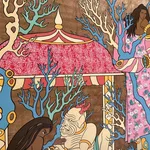
Caught in the Woods, 2026; situates movement and vulnerability within a dense, obstructed landscape, where passage is both physically and psychologically negotiated. A chariot-ornamented with visual motifs drawn from South Asian vernacular traditions-appears entangled within an overgrowth of branches, its halted state suggesting both containment and suspension. Within this confined space, a female figure occupies the chariot in a state of undress, her vulnerability made visible as if she is being seen by everyone, signaling exposure to the world rather than ease. Seated beside her is a mythic presence that, while retaining traces of menace, has been softened into a more ambiguous companion. The proximity between the two figures suggests not confrontation but a form of quiet recognition-fear is neither fully expelled nor dominant, but instead held, examined, and rendered familiar. What might once have functioned as a site of threat becomes a space of uneasy coexistence.
To the right, a larger female figure emerges, scaled beyond the immediate scene yet equally embedded within the encroaching landscape. Her composed, unwavering gaze and grounded posture introduce a counterpoint to the vulnerability of the chariot's interior. Rather than intervening directly, her presence operates as a form of watchfulness-protective without being possessive, assertive without spectacle. The surrounding environment-dense, enveloping, and resistant-echoes broader conditions of restricted movement within public space. Yet the work resists framing this condition solely through danger. Instead, it foregrounds alternative structures of support: protection is reimagined as lateral and collective, circulating between women rather than imposed from an external male authority. Materially, the incorporation of textiles sourced from garments worn by women within the artist's personal community embeds the surface with lived experience. These fabrics function as intimate traces, carrying the memory of everyday navigation, caution, and resilience, and extending the work into a shared, embodied register. Suspended between entrapment and agency, the painting does not resolve its tensions. Instead, it proposes a reframing of vulnerability-not as weakness, but as a condition through which awareness, adaptation, and forms of mutual care emerge.
To the right, a larger female figure emerges, scaled beyond the immediate scene yet equally embedded within the encroaching landscape. Her composed, unwavering gaze and grounded posture introduce a counterpoint to the vulnerability of the chariot's interior. Rather than intervening directly, her presence operates as a form of watchfulness-protective without being possessive, assertive without spectacle. The surrounding environment-dense, enveloping, and resistant-echoes broader conditions of restricted movement within public space. Yet the work resists framing this condition solely through danger. Instead, it foregrounds alternative structures of support: protection is reimagined as lateral and collective, circulating between women rather than imposed from an external male authority. Materially, the incorporation of textiles sourced from garments worn by women within the artist's personal community embeds the surface with lived experience. These fabrics function as intimate traces, carrying the memory of everyday navigation, caution, and resilience, and extending the work into a shared, embodied register. Suspended between entrapment and agency, the painting does not resolve its tensions. Instead, it proposes a reframing of vulnerability-not as weakness, but as a condition through which awareness, adaptation, and forms of mutual care emerge.