In Celebration of Spring: Brunch with Kavi Gupta with Narimon Safavi: KAVI GUPTA | WASHINGTON BLVD. FL.1-3


BRUNCH RECEPTION SATURDAY APRIL 11, 12-3PM
Join us for an intimate brunch celebrating the spring season and our current exhibitions, enjoy light fare and engaging conversations. This gathering offers a quieter moment to engage with the works on view and connect with the curators in a relaxed setting. Guests will enjoy light fare and conversation while experiencing works on view within MENASA+: Thresholds of Representation, and Continuing Resistance: A Century of Black Liberation (1925–2025) up close.
Narimon Safavi is a social entrepreneur and a media personality/arts commentator with appearances on WBEZ-NPR Chicago, BBC, PBS, El Diario Vasco, and Telecinco. He is the founder of Zaryab Art Labs, an innovative art center focused on the intersection of art and technology, to be located in a historic building in downtown Chicago and scheduled to open in February 2027.
Nari attended Illinois State University, studying Chemistry and Philosophy, with a keen interest in the Philosophy of Science. His current area of exploration is the epistemology of creativity and innovation. His community engagements have included board memberships at the Siskel Film Center (Art Institute of Chicago), Harris School of Public Policy at the University of Chicago, and the Latino Film Festival of Chicago, as well as a stint as a panelist at the National Endowment for the Arts in the USA for grant approvals. Narimon speaks English and Persian fluently and is conversant in Spanish and Azari Turkish.
MENASA+: THRESHOLDS OF REPRESENTATION
Bringing together artists from across the Middle East, North Africa, South Asia, Southeast Asia, and the Asian diaspora—these artist's lived experiences of migration, hybridity, and gender, redefine what global contemporary art can be. This curatorial framework positions MENASA+ and Asian diasporic dialogues not as categories, but as interconnected conditions of making—translation, survival, inheritance, reinvention, and resistance. It reflects a belief that identity in art is not fixed but continuously negotiated across borders, languages, and histories of gendered power. At a time when geopolitics continues to compress complex identities into binaries of “us” and “them,” the art world has mirrored similar patterns of exclusion and invisibility. This presentation resists that logic. It centers practitioners—particularly female and femme-identifying artists from MENASA+ and Asian regions—whose voices have emerged from unforgiving cultural and political contexts, yet continue to embody resilience, autonomy, and creative power.
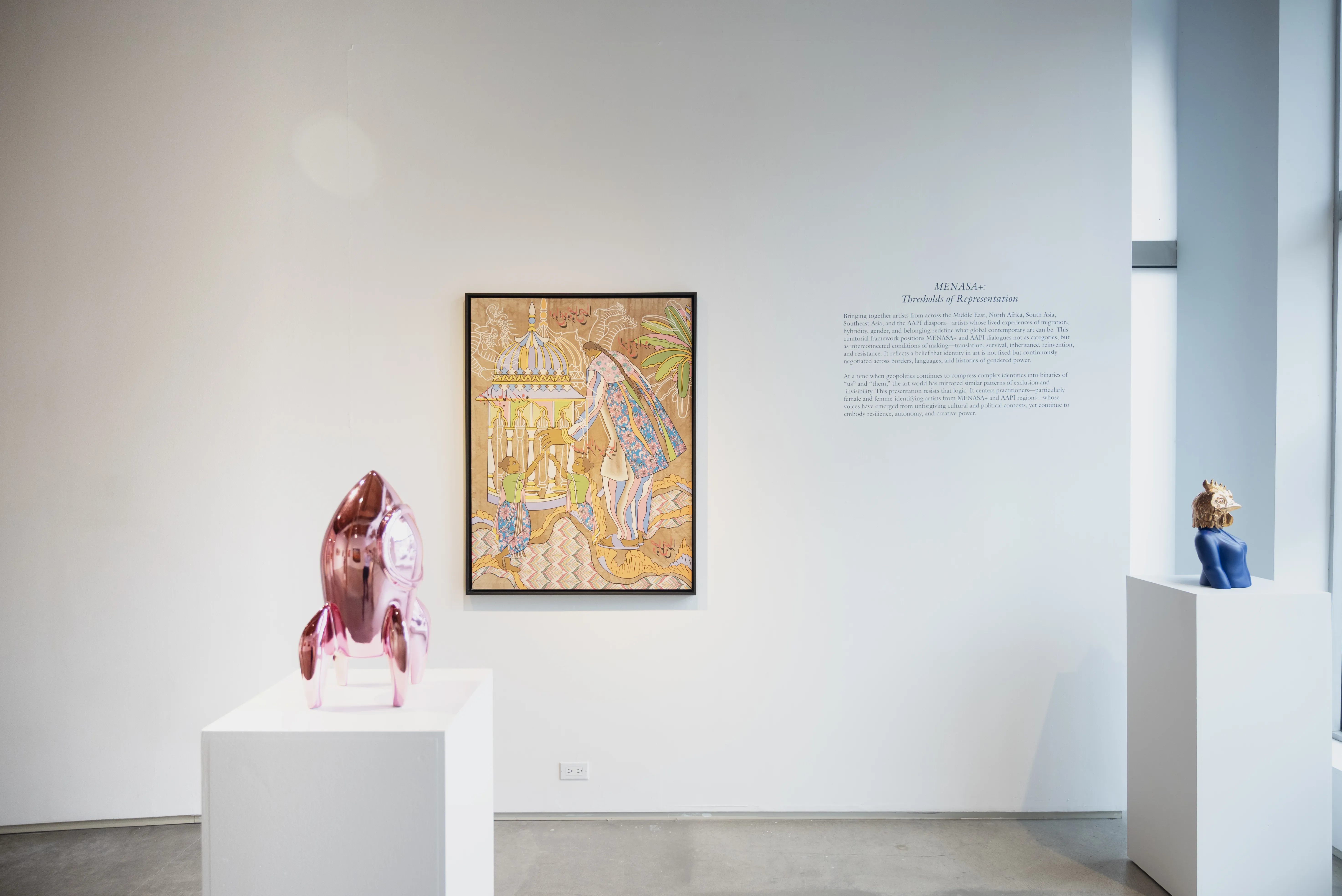
Installation View: MENASA+: Thresholds of Representation
This exhibition was made possible with curatorial assistance from Narimon Safavi, an Iranian-American entrepreneur and cultural commentator; and Rosa Matinfar, curator and writer whose work focuses on contemporary art from the MENASA region.
Continuing Resistance: A Century of Black Liberation (1925-2025)
Continuing Resistance: A Century of Black Liberation (1925–2025) positions artistic production within the Black radical tradition as an enduring site of political imagination and insurgent knowledge across a century of practice. Rather than framing resistance as episodic or reactive, the exhibition advances an understanding of resistance as a sustained praxis articulated through visual form, collective authorship, and the ongoing struggle for self-definition against regimes of erasure and containment. Bringing together contemporary artists alongside historic photographs and ephemera from the Kavi Gupta archive, the exhibition traces a visual genealogy that extends into the present. Across media, these works insist on aesthetic practice as a mode of sovereignty: a space in which representation exceeds documentation to become an act of world-building, refusal, and self-determination. Spanning generations, the presentation foregrounds the development of visual languages capable of holding both historical memory and speculative futurity. The exhibition proposes that Black liberation is not merely represented through art but materially produced by it; through images that preserve communal memory, contest dominant epistemologies, and expand the conditions of visibility. Within this framework, artistic practice emerges not as symbolic response alone but as durable cultural infrastructure, continuing to shape the political, social, and imaginative horizons of the present.
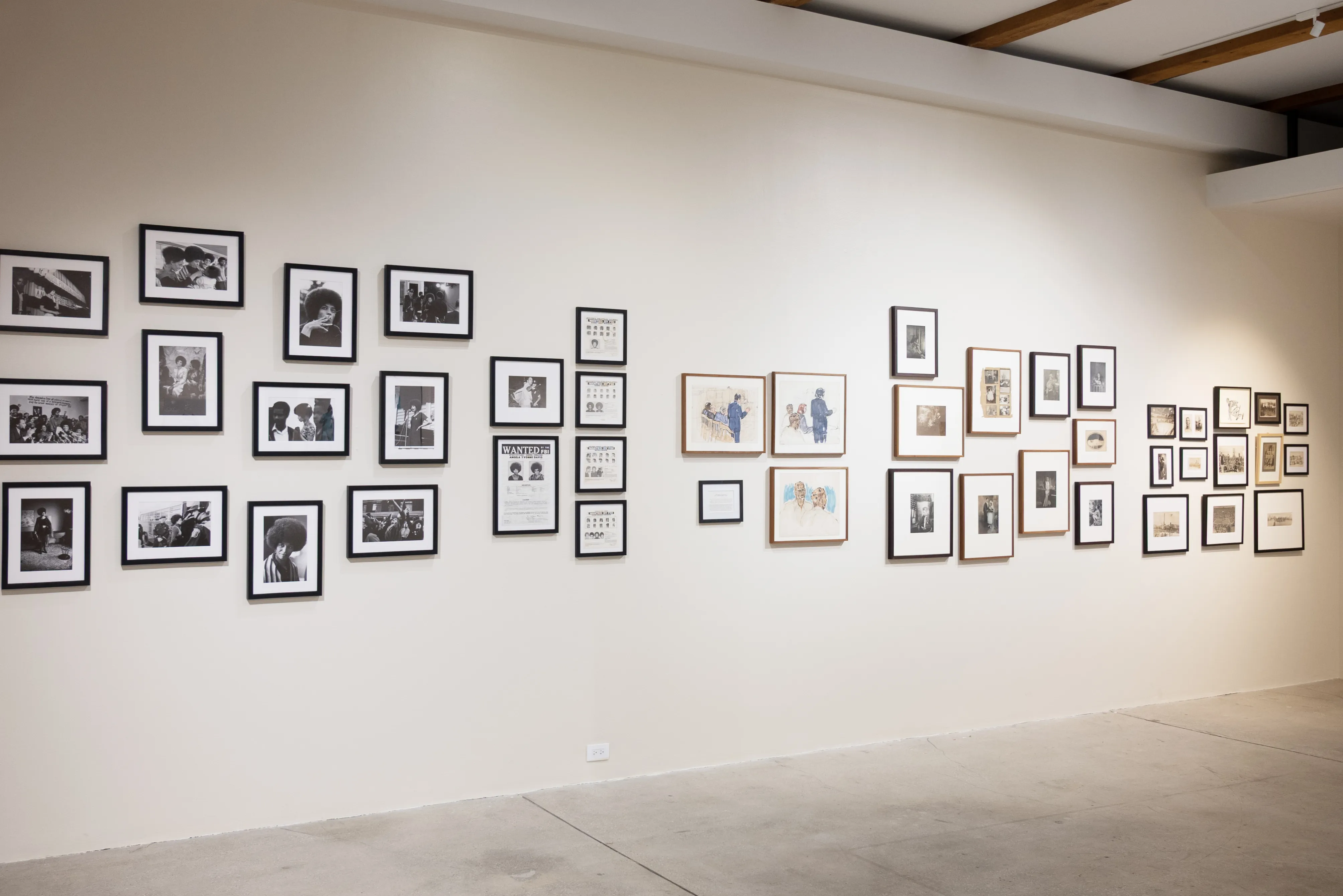 Installation View: Continuing Resistance: A Century of Black Liberation (1925–2025)