
In the quiet intimacy of a photo album, history speaks differently. Removed from the walls of institutions and the authority of the frame, photographs become something closer to memory; handled, revisited, and lived with. These pages of James Van Der Zee's personal albums offer this rare proximity: an autobiographical record of a life.
Among the most distinctive works of Van Der Zee in the Kavi Gupta | Archives, these personal photographs, assembled by Van Der Zee, commemorate his unique perspective.

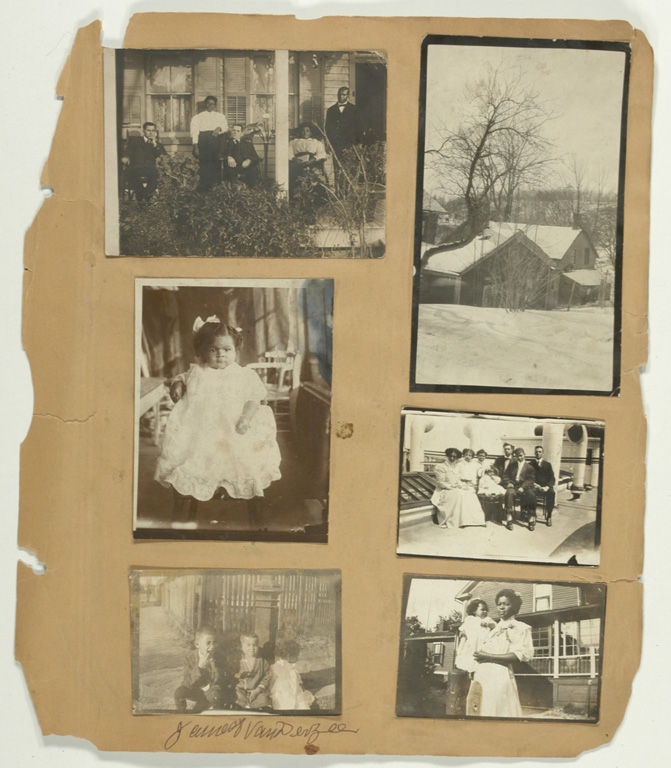
James Van Der Zee b. 1886 - d. 1983, Album pages from the artist's personal photo album, each with six mounted photographs, 1910.
Best known for his studio portraits of Harlem in the early twentieth century, Van Der Zee shaped a visual language of Black dignity, aspiration, and self-possession that continues to resonate today. Within his personal albums, that same sensibility unfolds more privately and more expansively through tender domestic moments, community documents, and quiet landscapes. Together, these images offer rare and unguarded views of the broader social world he inhabited. Van Der Zee stands as a peerless documentarian and artist of his era.

James Van Der Zee b. 1886 - d. 1983, Album page from the artist's personal photo album, with six mounted photographs, 1910. Captions: Landscape images with written location, Portrait titled 12. Group of Natives

James Van Der Zee b. 1886 - d. 1983, Album page from the artist's personal photo album, with six mounted photographs, 1910. Captions: Landscape images captioned Jacksonville, FL
To spend time with these albums is to witness the construction of an archive from the inside out. Each hand-tipped image accumulates meaning through its placement beside others, and the uniquely personal context they are held in.
Across these album pages, Van Der Zee's attention turns outward toward landscape, architecture, and the everyday choreography of public life. Handwritten captions identify sites and their surroundings. Hotels, riverbanks, residential streets, avenues framed by trees, modest homes, agricultural land, and civic buildings transform each photograph into both image and record. These are not grand monuments but lived environments: people gathered at the water's edge, figures posed casually along sidewalks, laborers standing beside carts, children assembled for a group portrait. The photographs suggest an artist attuned to atmosphere and structure alike, studying how light falls across buildings, how streets recede into perspective, how communities inhabit space.

James Van Der Zee b. 1886 - d. 1983, Album pages from the artist's personal photo album, each with six mounted photographs, 1910.
What becomes visible here is an early documentary impulse: an impulse to name, to situate, to preserve. The albums read almost as a personal atlas, shaped by movement through the world and by a careful desire to hold onto what was seen. In this way, the pages function not only as collections of images, but as acts of authorship where handwriting, sequencing, and selection work together to construct meaning. The result is a portrait of an artist developing his eye through attention to place, rhythm, and the social textures of daily life.

James Van Der Zee b. 1886 - d. 1983, Album page from the artist's personal photo album, with six mounted photographs, 1910.
"You can see the picture before it's taken; then it's up to you to get the camera to see."- James Van Der Zee
These photographs give insight to Van Der Zee's life and practice, with such imagery as of his wife and child (bottom right). These rare pages of Van Der Zee's photo-albums are minor collections in-and-of themselves, assemblies of important photographs which were brought together by Van Der Zee's own hand for their personal value, rather than on the whims of a curator or historian. The photographs on the page below are some of the most intimate, and others give us rare and unspoiled views of Van Der Zee's own family, his place of work, his home, and the world in which he lived.
Kavi Gupta | Archives

